
What Happens When The Insurance Company Says You Caused The Accident?
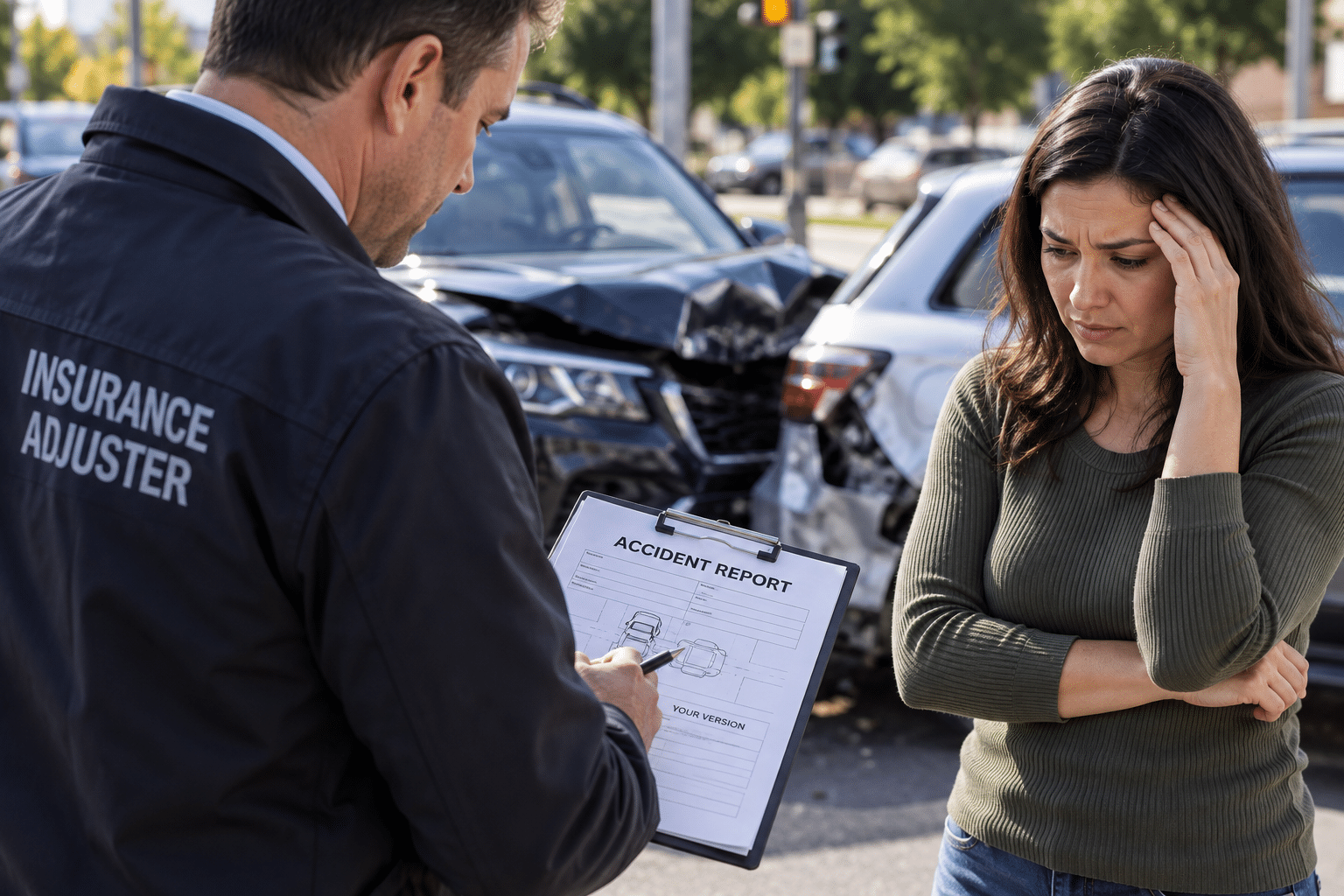
It can be very frustrating when an insurance company blames you for a car accident in Detroit, especially if you know their version of events is wrong. An adjuster might say you caused the crash, played a part in it, or were more at fault than the other driver. This decision can affect how much money the insurer offers, but it does not decide your legal rights. Insurance companies base their decisions on their own investigations, but you can challenge those findings. We always review the evidence ourselves because, under Michigan law, fault is based on what really happened, not just what an adjuster writes in a report.
Car accident cases in Michigan can include different types of benefits and damages. Fault can impact a claim against another driver, but some No-Fault benefits may still be available no matter who caused the accident. When there is a disagreement about who is responsible, evidence becomes very important. Things like police reports, witness statements, vehicle damage, videos, photos, and electronic data from vehicles can all help decide who is at fault.
An Insurance Company’s Fault Decision Is Not Final
An insurance adjuster does not have the final legal authority to determine who caused an accident. The insurer may make an internal liability decision for purposes of handling the claim, but that decision can be disputed through further negotiation or litigation.
We often see fault determinations based on incomplete information. An insurer may rely heavily on its insured driver’s statement, a brief police report, or assumptions about how a collision usually occurs. Additional evidence can present a much different picture.
If a lawsuit is filed and the parties continue to dispute responsibility, fault may ultimately be decided by a judge or jury based on the admissible evidence.
Michigan Uses Comparative Fault
Michigan applies comparative-fault principles to many personal injury claims. Under MCL 600.2959, damages may be reduced according to the injured person’s percentage of fault. The statute also provides an important limit for noneconomic damages. If the injured person is more than 50 percent at fault, recovery of noneconomic damages may be barred.
Michigan’s motor vehicle tort statute, MCL 500.3135, likewise provides that damages in qualifying auto injury claims are assessed according to comparative fault and that damages are not assessed in favor of a party who is more than 50 percent at fault for purposes covered by that section.
For example, if damages subject to comparative fault total $200,000 and an injured person is found 20 percent responsible, the award may be reduced according to that percentage. This is why insurance companies may aggressively argue that an injured person contributed to a crash.
Why Insurance Companies Try To Shift Blame
Every small amount of fault can change how much money an insurance company has to pay. Because of this, insurers often look for reasons to blame the injured person, such as speeding, being distracted, following too closely, not yielding, making unsafe lane changes, or breaking other traffic rules.
Sometimes those arguments have legitimate factual support. Other times, they are based on speculation or incomplete evidence.
We never just accept the insurance company’s version of fault. We look at how the vehicles moved before the crash, where the damage is, what independent witnesses saw, if there is any video, and whether the physical evidence matches the insurer’s story.
What Evidence Can Challenge A Fault Determination?
The best response to an unfair liability decision is evidence.
Police reports can be helpful, but they are just one piece of the puzzle. Photos of the cars, skid marks, debris, the layout of the intersection, and damage can help explain what happened. Dashcams, security cameras, traffic cameras, and recordings from nearby businesses or homes can also be very useful.
Witness testimony may become especially important when the drivers give conflicting accounts. In serious cases, accident reconstruction may help establish speed, direction of travel, braking, impact angles, and other factors.
We also look at electronic information when appropriate. Modern vehicles can contain event data that may help show speed, braking, seat belt use, and other information immediately before a collision.
What If The Police Report Says You Were At Fault?
A police report can affect how an insurer initially views a claim, but the report does not necessarily control the outcome of a civil injury case.
The responding officer may not have witnessed the collision. The officer may instead rely on statements made at the scene, visible vehicle damage, and other information available immediately after the crash. Important evidence may surface later.
We review the report against photographs, witness testimony, video, medical records, and other available evidence. If the report contains an error or does not tell the full story, we do not treat the insurer’s reliance on it as the end of the case.
Fault And Michigan No-Fault Benefits Are Different Issues
An accusation that you caused the collision does not necessarily mean you lose access to all automobile insurance benefits.
Michigan’s No-Fault system provides Personal Injury Protection benefits subject to statutory eligibility rules and policy terms. Under MCL 500.3107, qualifying PIP benefits can include reasonable and necessary expenses for an injured person’s care, recovery, or rehabilitation, as well as qualifying work-loss and replacement-service benefits.
These benefits operate differently from a liability claim against another driver. A person may therefore have PIP rights even when responsibility for the collision is disputed.
When You May Bring A Claim Against The Other Driver
To pursue noneconomic damages such as pain and suffering against an at-fault motorist, Michigan’s automobile tort law generally requires the injury to satisfy the threshold established by MCL 500.3135.
The statute permits tort liability for noneconomic loss when an injured person suffers death, permanent serious disfigurement, or a serious impairment of body function. Whether an injury meets that standard depends on the medical evidence and how the impairment affects the person’s life.
Fault remains important. Even a serious injury claim can be reduced or defeated if the evidence establishes a sufficiently high percentage of responsibility on the injured person’s part.
Be Careful About Statements Made To Insurance Adjusters
When fault is disputed, seemingly casual statements can become important. An adjuster may ask whether you saw the other vehicle, how fast you were traveling, whether you were distracted, or whether you could have avoided the collision.
We advise injured people to be careful about making assumptions or accepting blame simply because they are unsure exactly what happened. Serious crashes occur quickly, and an injured person may not immediately understand every detail.
A recorded statement can later be compared with deposition testimony, medical records, or other evidence. Before giving detailed statements about liability to an opposing insurer, it can be important to understand your rights.
Why Acting Quickly Can Strengthen A Disputed-Fault Case
Evidence does not remain available forever. Businesses may overwrite surveillance recordings. Vehicles may be repaired or destroyed. Witnesses can become difficult to locate, and memories fade.
When we handle a disputed-liability case, we begin looking for evidence that can independently show how the collision occurred. Early investigation can make the difference between relying solely on two conflicting driver statements and having objective evidence that establishes what actually happened.
Frequently Asked Questions About Insurance Companies Blaming You For A Michigan Accident
Can The Insurance Company Deny My Claim Just Because It Says I Caused The Crash?
An insurer can deny or reduce a liability claim based on its investigation, but its decision is not necessarily the final word. We can challenge a liability determination with additional evidence, legal arguments, settlement negotiations, and, when appropriate, litigation. If the case reaches court, the insurer does not simply get to dictate the percentage of fault.
Can I Recover Compensation If I Was Partially At Fault?
Potentially, yes. Michigan applies comparative-fault principles. Under MCL 600.2959, damages may be reduced according to your share of responsibility. Michigan motor vehicle claims are also subject to the comparative-fault provisions of MCL 500.3135. Being partially responsible does not automatically eliminate every claim, although being more than 50 percent at fault can bar recovery of certain noneconomic damages.
What If The Other Driver Is Lying About How The Accident Happened?
Conflicting stories are common in car accident cases. We look for evidence that does not depend entirely on either driver’s version. Vehicle damage, photographs, witness statements, surveillance recordings, dashcam video, electronic vehicle information, and accident reconstruction can sometimes establish what occurred more reliably than competing statements.
Does A Traffic Ticket Prove Who Was Responsible For The Accident?
A citation can be relevant, but fault in a civil personal injury case involves a separate legal analysis. We examine all available evidence rather than assuming a ticket alone settles liability. The circumstances surrounding the violation, causation, and the conduct of every driver may need to be evaluated.
Should I Give The Other Driver’s Insurance Company A Recorded Statement?
We generally recommend caution before giving an opposing insurer a recorded statement. Adjusters may ask detailed questions about speed, visibility, distractions, injuries, and whether you believe you could have prevented the crash. Statements made early can later be used during the claim process. We can communicate with the opposing insurance company and help protect our client’s position when liability is disputed.
Can I Still Receive Michigan No-Fault Benefits If I Caused The Accident?
Potentially, yes. Michigan PIP benefits are governed by separate statutory rules and eligibility requirements. Under MCL 500.3107, available benefits may include qualifying medical expenses, wage loss, and replacement services. Fault in causing the collision is not necessarily the same issue as eligibility for PIP benefits, although exclusions and coverage rules can affect a particular claim.
Let Ravid & Associates, P.C. Fight For Your Full Compensation
Being blamed by an insurance company does not mean you should give up on your injury claim. We investigate how the collision happened, preserve evidence, examine Michigan comparative-fault law, and challenge allegations that unfairly shift responsibility to our clients. When serious injuries are involved, determining the correct allocation of fault can have a major effect on the compensation available.
If an insurance company is blaming you for a Detroit or Michigan car accident, call our Detroit auto accident attorneys at Ravid & Associates, P.C. today by calling (248) 948-9696 to receive your free consultation. We represent injured people in Detroit and throughout the entire state of Michigan from our office locations in Southfield, Michigan. We can review the evidence, evaluate the insurer’s fault determination, and explain the legal options available for pursuing your injury claim.

