
Can Another Driver Be Responsible For Causing A Crash In Michigan Without Hitting My Vehicle?
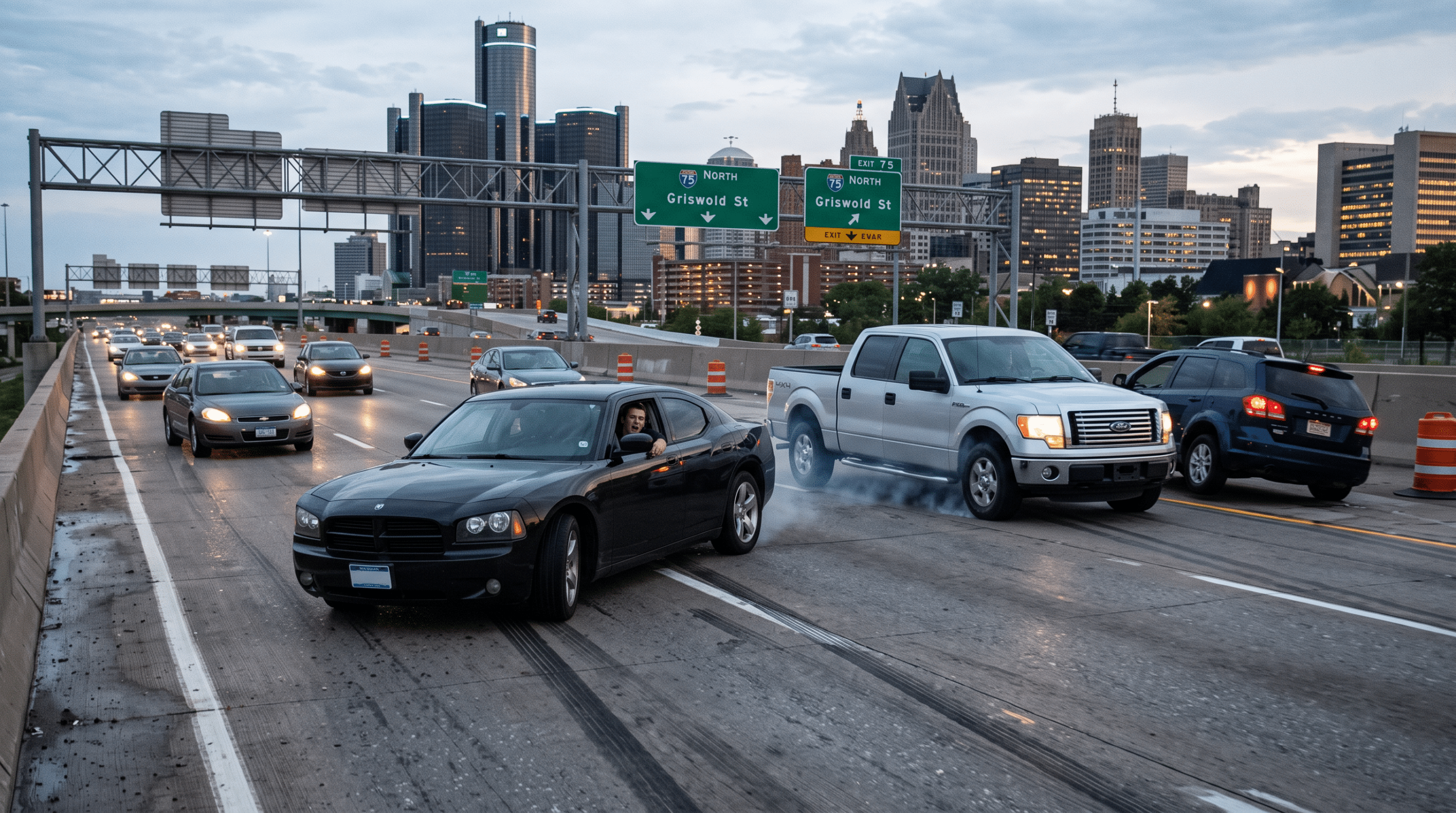
A driver can be responsible for a Michigan car accident even if they never hit your vehicle. For example, a reckless lane change, failing to yield, or suddenly entering traffic can force another driver to swerve, brake hard, leave the road, or hit another car. These are called no-contact crashes because the at-fault vehicle never actually touches yours. While the lack of contact can make it harder to prove what happened, it does not mean the other driver is off the hook. We focus on what started the chain of events, not just which cars collided.
When we look into these accidents, we ask if another driver’s actions forced you to react suddenly, leading to the crash. Michigan traffic laws set rules for lane changes, speed, yielding, and safe driving. If a driver breaks these rules and causes a predictable accident, their actions can be a key part of your personal injury claim in Detroit.
How A Driver Can Cause An Accident Without Making Contact
Imagine you are driving on I-75 and another driver suddenly moves into your lane without looking. You have just seconds to react. If you swerve to avoid them and end up hitting a barrier, another car, or a guardrail, that driver may still be responsible for the accident, even though your vehicles never touched.
Other examples include a driver pulling out of a driveway, running a stop sign, turning across traffic, merging unsafely, or cutting across several lanes. A motorcyclist might be forced off the road, or a car could be pushed into oncoming traffic while trying to avoid a crash. Sometimes, one driver’s mistake causes a chain reaction, leading to several vehicles crashing while the at-fault driver keeps going.
That’s why we look at the whole series of events, not just the moment when cars actually hit each other.
Michigan Lane Change Laws Can Be Important
Michigan law requires drivers to make lane movements safely. Under MCL 257.642, a vehicle generally must remain within a single lane and should not leave that lane until the driver has first determined that the movement can be made safely.
This rule is especially important in no-contact accidents caused by unsafe merging or sudden lane changes. If another driver moves into your lane when it isn’t safe and you have to react quickly, proof of their movement can help support a negligence claim.
Michigan law also requires drivers to exercise care when changing direction. MCL 257.648 addresses turning and stopping movements and requires appropriate signaling under circumstances covered by the statute. Failure to signal may become another relevant fact when determining how and why the crash occurred.
Failure To Yield Can Cause A No-Contact Collision
Intersection accidents provide another common example. Under MCL 257.649, Michigan drivers have specific duties to yield the right-of-way in intersection situations.
For example, if another car enters an intersection right in front of you when you have the right-of-way, you might swerve to avoid it and end up hitting a different vehicle. Even though you didn’t hit the car that caused the emergency, that driver may still be responsible.
To figure out what happened, we look at things like traffic signals, intersection cameras, where the vehicles ended up, witness statements, skid marks, and other evidence.
Speed And Careless Driving Can Also Cause These Accidents
A driver does not need to violate a posted speed limit to be driving too fast for existing conditions. MCL 257.627 requires motorists to operate at a careful and prudent speed that is reasonable and proper considering traffic, road, and other existing conditions.
Michigan also prohibits careless or negligent vehicle operation under MCL 257.626b. A motorist who drives carelessly enough to force other drivers into evasive maneuvers may therefore face consequences even without making physical contact.
The specific traffic violation is important, but our civil claim ultimately focuses on whether the driver’s negligent conduct caused the accident and resulting injuries.
Proving Which Driver Caused The Crash
Evidence becomes particularly important when the vehicles never touched. The responsible driver may claim that they never entered your lane or that your own driving caused the collision.
We may investigate:
• Dashcam, surveillance, or traffic-camera recordings.
• Independent eyewitness statements.
• Police reports and 911 recordings.
• Vehicle event data and electronic records.
• Photographs, skid marks, debris, and vehicle damage.
• Information identifying the vehicle that left the scene.
A witness who saw another driver cut you off, for example, can substantially change the evidence available in the case. Video footage can be even more valuable because some surveillance systems overwrite recordings quickly.
What Happens If The Other Driver Leaves The Scene?
No-contact accidents become more complicated when the driver who triggered the crash keeps going. That person may not even realize that an accident occurred, or the driver may intentionally leave to avoid responsibility.
We may look for nearby business cameras, traffic cameras, dashcam recordings, witnesses, partial license plate numbers, distinctive vehicle features, and police investigation materials. Identifying the vehicle may make it possible to pursue its driver and applicable liability insurance.
If the driver cannot be identified, we also review every potentially applicable insurance policy. Uninsured motorist coverage may become relevant in some circumstances, but coverage depends heavily on the wording and requirements of the particular insurance policy. We do not assume coverage exists merely because the responsible vehicle disappeared.
Michigan No-Fault Benefits May Still Apply Without Vehicle Contact
Physical contact with the negligent vehicle is not necessarily required for Michigan Personal Injury Protection benefits.
Under MCL 500.3105, PIP benefits apply to accidental bodily injury arising out of the ownership, operation, maintenance, or use of a motor vehicle as a motor vehicle, subject to the requirements and limitations of Michigan’s No-Fault Act. MCL 500.3114 addresses the priority rules that determine which insurer may be responsible for PIP benefits for people injured while occupying motor vehicles.
Depending on the facts and applicable coverage, these benefits may address qualifying medical expenses, wage loss, replacement services, and other benefits authorized under Michigan law.
Can We Pursue Pain And Suffering Damages?
A separate third-party liability claim may allow compensation beyond applicable no-fault benefits.
Under MCL 500.3135, a person may pursue noneconomic damages arising from the ownership, maintenance, or use of a motor vehicle when the statutory threshold is met. The statute recognizes death, permanent serious disfigurement, or serious impairment of body function as qualifying categories.
For serious injuries, we examine how the condition affects work, mobility, household responsibilities, recreation, family activities, and other parts of the injured person’s normal life.
Comparative Fault Can Affect A No-Contact Accident Claim
The other driver’s insurance company may argue that you overreacted or could have avoided the crash differently. That makes Michigan’s comparative-fault rules particularly important.
Under MCL 600.2959, damages can be reduced according to the injured person’s percentage of comparative fault. Michigan’s motor-vehicle tort provisions in MCL 500.3135 also contain comparative-fault rules affecting noneconomic damages.
We therefore work to show why the evasive action was reasonable under the circumstances. A driver confronted with another vehicle suddenly entering the lane may have only a fraction of a second to react. The event must be evaluated based on what actually confronted the driver at that moment.
How Long Do We Have To File A Michigan Injury Lawsuit?
Michigan generally provides a three-year limitations period for actions seeking damages for personal injury under MCL 600.5805, although different deadlines and notice requirements can apply to particular claims.
No-contact crashes should be investigated much sooner than that. Video can disappear, witnesses become harder to locate, and identifying an unknown vehicle becomes increasingly difficult as time passes. Early investigation may determine whether we can establish what caused the accident.
Talk To Ravid & Associates, P.C. About Your No-Contact Michigan Car Accident
A driver should not escape potential responsibility simply because you managed to avoid hitting that driver’s vehicle. When another motorist’s unsafe lane change, failure to yield, reckless maneuver, or other negligent conduct causes a serious crash, we investigate the entire chain of events. We work to identify the responsible parties, preserve evidence, determine available insurance coverage, document injuries, and pursue compensation available under Michigan law.
If another driver forced you off the road, caused you to strike another vehicle, or triggered an accident without actually hitting your car, call our Detroit car accident lawyers at Ravid & Associates, P.C. today by calling (248) 948-9696 to receive your free consultation. We represent injured people in Detroit and throughout the entire state of Michigan from our office locations in Southfield, Michigan. We can review how the crash happened, investigate the driver who caused it, and determine what claims and insurance benefits may be available.

