
What To Do When The Insurance Company Refuses To Pay Your Injury Claim
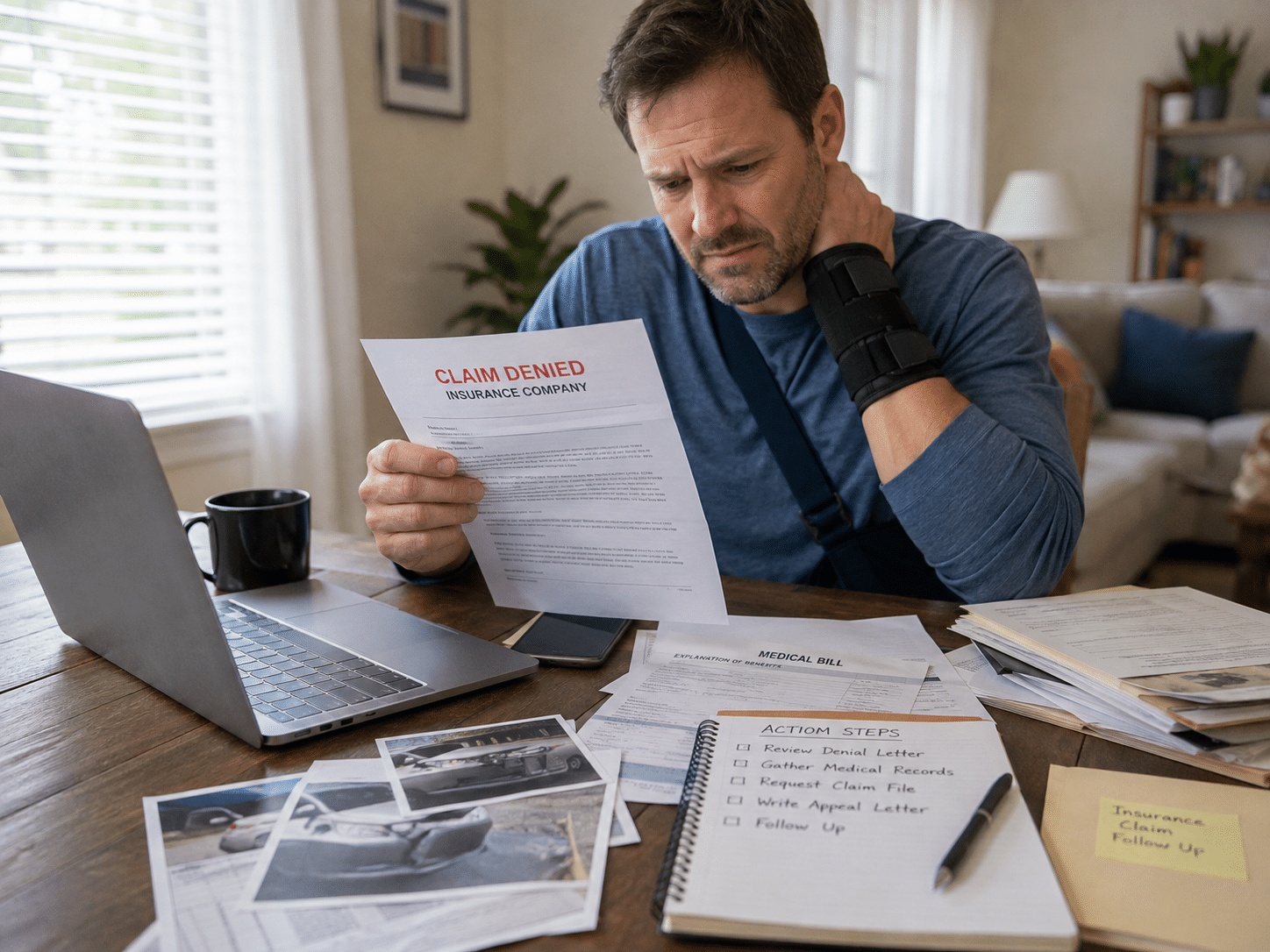
When an insurance company refuses to pay an injury claim, it can leave you in a tough spot. Medical bills might keep coming, your income could be affected, and you may still need treatment while the insurer argues about responsibility or the seriousness of your injuries. But a denial does not always mean your claim is finished. Insurers may deny claims for several reasons, such as disputing who was at fault, questioning your medical care, claiming your injury existed before the accident, or saying the policy does not cover your situation. We help people in Detroit figure out why their claim was denied, what evidence could help overturn that decision, and whether a lawsuit is needed to seek compensation.
In Michigan, injury claims can involve several insurance companies and different legal rights. For example, if you are in a car accident, you might have a first-party claim for Michigan No-Fault benefits and a separate third-party claim against the driver who caused the crash. The first thing to do is find out which insurance company denied your claim and why, so you know how to move forward.
Find Out Exactly Why The Insurance Company Denied The Claim
First, we need to find out the exact reason the insurer gave for refusing payment. A brief phone explanation is not enough to fully understand the issue. You should review the denial along with your insurance policy, medical records, accident reports, and any letters or emails with the adjuster.
The insurance company might say their customer did not cause the accident. They could also claim your medical condition existed before the crash, that your treatment was not needed, that there is not enough proof linking your injury to the accident, or that the policy does not cover your situation. Sometimes, the disagreement is about how much money should be paid, not whether you deserve compensation.
Once we understand the insurer’s position, we can determine what evidence is needed to challenge it.
Preserve The Evidence Supporting Your Injury Claim
An injury claim depends on solid evidence, not just the fact that an accident happened. You need medical records that show what injuries you have, how they are connected to the accident, what treatment you needed, and how your condition affects your work and daily life.
Things like police reports, photos, witness statements, videos, vehicle damage, job records, and medical records can all be important. In serious car accidents, electronic data from the vehicle or accident reconstruction reports can also help show how the crash happened.
Medical treatment should remain consistent with your doctors’ recommendations. Large gaps in treatment can give an insurer another argument for disputing whether the accident caused the continuing symptoms.
Understand The Difference Between A PIP Denial And A Liability Claim Denial
Michigan’s No-Fault system creates different claims following many automobile accidents. Personal Protection Insurance benefits may provide payment for allowable accident-related expenses and certain other benefits without requiring you to prove that another driver caused the crash.
A dispute over PIP benefits is therefore different from a claim against the negligent driver for damages.
Under MCL 500.3142, PIP benefits generally become overdue when they are not paid within 30 days after the insurer receives reasonable proof of the fact and amount of the loss. Michigan law provides for 12 percent simple interest on overdue benefits. When an insurer unreasonably refuses to pay or unreasonably delays payment, MCL 500.3148 may also permit recovery of attorney fees under the circumstances provided by the statute.
We examine precisely which benefits were denied, what proof was submitted, and whether the insurer had a legitimate basis for withholding payment.
Challenge A Denial Of Pain And Suffering Compensation
A liability insurer may refuse to compensate a Michigan car accident victim for pain and suffering by arguing that the insured driver was not at fault or that the injuries fail to satisfy Michigan’s legal threshold.
Under MCL 500.3135, a person injured in a motor vehicle accident may pursue noneconomic damages when the accident causes death, permanent serious disfigurement, or a serious impairment of body function. Michigan law defines serious impairment by examining whether there is an objectively manifested impairment of an important body function that affects the injured person’s general ability to lead their normal life.
We therefore look beyond the diagnosis alone. We document what the injury has actually changed. Restrictions involving work, walking, driving, household responsibilities, recreation, sleep, and family activities can become significant evidence when the insurance company questions the seriousness of the injury.
Do Not Assume The Insurance Company’s Fault Decision Is Final
An adjuster’s opinion about fault is not a court judgment. Insurance companies may deny liability because their insured gives a different account of the collision or because the insurer believes there is enough uncertainty to contest the claim.
Michigan’s comparative-fault statute, MCL 600.2959, can also affect compensation. An insurer may attempt to assign some or most of the responsibility for an accident to the injured person in an effort to reduce what it must pay.
We can independently investigate the collision rather than relying exclusively on the insurance company’s version of events. Witness accounts, traffic-camera recordings, surveillance footage, photographs, crash data, and physical evidence can sometimes establish responsibility more clearly than an initial insurance investigation.
Consider Whether Filing A Lawsuit Is Necessary
When additional documentation and settlement negotiations do not resolve the dispute, litigation may be required. Filing suit allows us to obtain evidence through discovery, question witnesses under oath, request documents, and ultimately ask a judge or jury to decide contested issues.
Deadlines make delay dangerous. Under MCL 600.5805, Michigan generally provides a three-year limitations period for many actions involving personal injury. No-Fault PIP disputes are governed by separate timing provisions under MCL 500.3145, including important restrictions concerning when actions must be filed and which overdue benefits may be recovered.
We do not assume every denied claim has the same deadline. We determine which type of claim is involved and identify the applicable limitation period before valuable legal rights are lost.
Michigan Law Regulates Certain Insurance Claim Practices
Michigan law also addresses insurance claim handling. MCL 500.2026 identifies certain unfair or deceptive practices involving insurance claims when they constitute the type of conduct addressed by the statute. Examples include specified claim-handling practices relating to investigation, communication, settlement, and payment.
That does not mean every disputed or denied claim automatically creates a separate lawsuit against an insurance company. A legitimate disagreement can exist over liability, coverage, causation, or damages. We examine the facts and applicable insurance statutes rather than assuming that a denial itself proves unlawful conduct.
A Denied Injury Claim May Still Be Worth Pursuing
We do not consider an insurance company’s first answer to be the final measure of an injury case. A denial sometimes exposes the precise weaknesses the insurer believes exist, allowing us to focus on obtaining the evidence needed to address them.
The right response depends on the reason for denial. That may involve obtaining additional medical opinions, locating witnesses, challenging comparative-fault allegations, documenting future damages, demanding overdue No-Fault benefits, or filing litigation against the responsible parties.
FAQs About Insurance Companies Refusing To Pay Michigan Injury Claims
What Should We Do First After An Insurance Company Denies An Injury Claim?
We should determine exactly why the claim was denied. The denial letter, policy language, medical records, accident evidence, and previous communications with the adjuster should all be reviewed. Once the insurer’s reasoning is clear, we can determine whether additional evidence, further negotiation, or litigation offers the strongest response. We also identify all applicable deadlines because waiting while repeatedly arguing with an adjuster can put legal rights at risk.
Can An Insurance Company Deny A Claim Because We Had A Pre-Existing Injury?
An insurer may raise a pre-existing condition as a defense, but the existence of an earlier medical problem does not automatically defeat a claim. A motor vehicle collision may aggravate or worsen a prior condition. We compare medical records from before and after the accident, treating physicians’ findings, diagnostic testing, and changes in symptoms or physical ability. The important issue is often what the collision actually caused or worsened rather than whether a body part had ever been injured before.
What Happens If The Insurance Company Says The Accident Was Our Fault?
We can challenge the insurer’s fault determination. Michigan comparative-fault rules can reduce damages when an injured person shares responsibility, but an insurance adjuster does not have the final authority to decide fault. We may obtain witness statements, photographs, video recordings, police records, vehicle data, and other evidence to establish what happened. If the dispute cannot be resolved, fault can ultimately become an issue for a court or jury.
Can We Sue For Unpaid Michigan No-Fault Benefits?
A lawsuit may be appropriate when an insurer wrongfully withholds PIP benefits that are payable under Michigan law and the applicable policy. Under MCL 500.3142, qualifying PIP benefits can become overdue after the insurer has received reasonable proof of the fact and amount of the loss, and overdue benefits can carry statutory interest. MCL 500.3148 can also become relevant when an insurer unreasonably refuses payment or unreasonably delays payment. PIP litigation has strict timing requirements, so prompt review is important.
Should We Keep Talking To The Insurance Adjuster After A Claim Is Denied?
We should be careful about giving additional statements without understanding why the claim was denied. Anything said to an adjuster can become part of the claim file and may later be used to challenge fault, causation, or damages. Once a serious claim has been disputed, we generally want the evidence and policy reviewed before additional substantive discussions take place.
Ravid & Associates, P.C. Can Challenge A Denied Michigan Injury Claim
When an insurance company refuses to pay, we can investigate the denial rather than accepting the insurer’s decision at face value. We examine liability, insurance coverage, medical causation, damages, No-Fault benefits, and the evidence the carrier is relying upon. When appropriate, we pursue payment through negotiation or litigation and work to hold responsible parties and insurers to their obligations under Michigan law.
If an insurance company has denied, delayed, or refused to properly pay your Michigan injury claim, call our Detroit car accident attorneys at Ravid & Associates, P.C. today by calling (248) 948-9696 to receive your free consultation. We represent injured people in Detroit and throughout the entire state of Michigan from our office locations in Southfield, Michigan. We can review the denial, explain your legal options, and determine what action may be taken to pursue the compensation and insurance benefits available under Michigan law.

