
How To Prove The Other Driver Ran A Red Light Causing The Accident
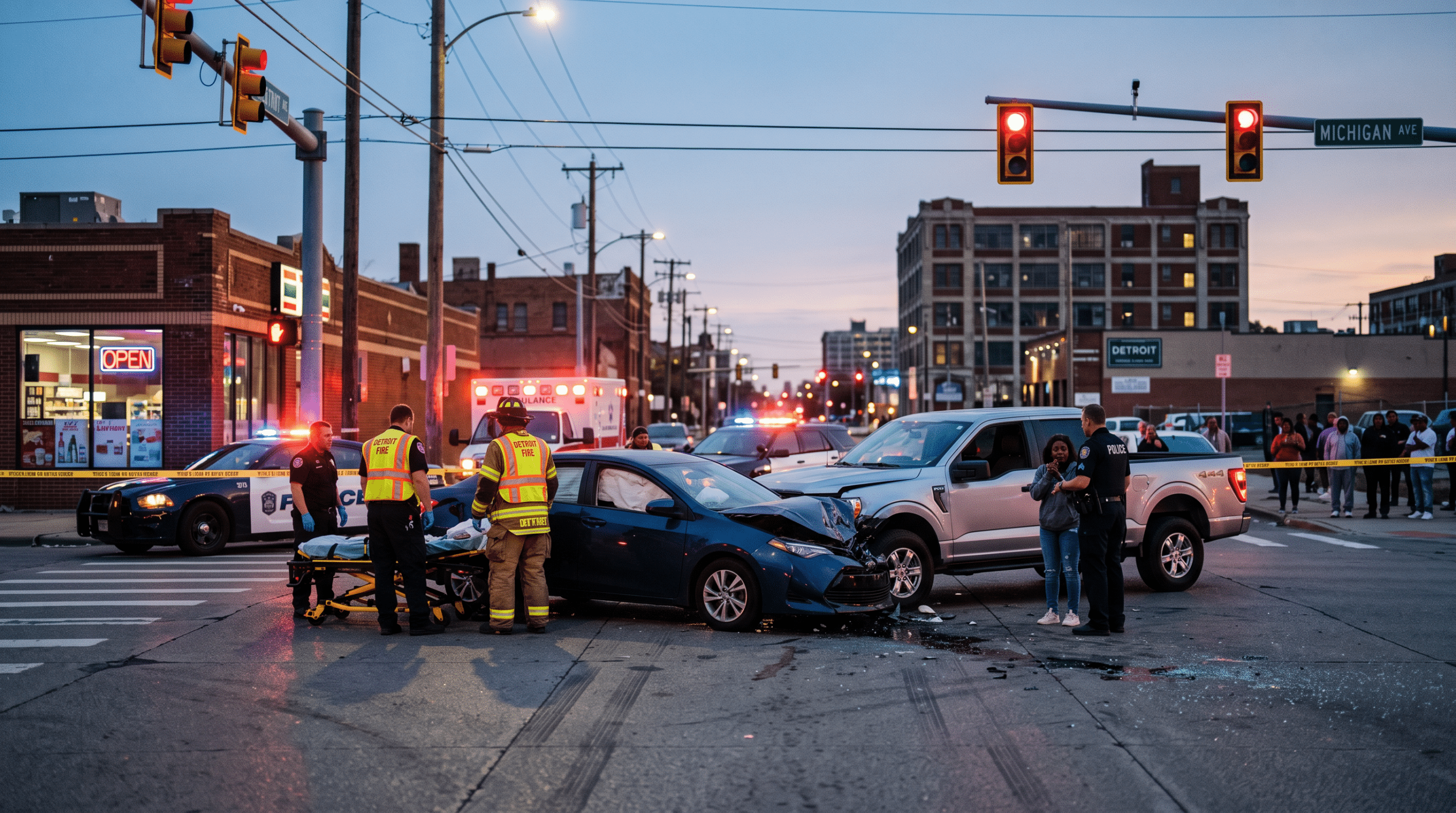
A red-light crash happens quickly, but figuring out what really occurred often takes careful investigation. These accidents in Detroit can cause serious injuries, since one car may be driving through the intersection at normal speed while another crosses in front of it. Afterward, drivers often disagree about which light was red and who had the right of way. Insurance companies may use these disagreements to delay payments, lower settlement offers, or deny responsibility. That’s why collecting evidence after a Michigan intersection accident is just as important as what each driver remembers.
We help injured drivers who need to show that another driver entered an intersection while the light was red. Michigan law says drivers must stop at a steady red light, except in certain cases where turning on red is allowed. MCL 257.612 explains what Michigan traffic signals mean and what drivers must do. If a driver breaks this rule and causes a crash, proof of the violation can be key to showing negligence.
Start With What Happened At The Intersection
The basic liability question is whether the other motorist entered the intersection when the traffic signal required that driver to stop. Under MCL 257.612, a driver facing a steady red indication generally must stop before entering the crosswalk or intersection and remain stopped until movement is permitted.
This might seem straightforward, but it’s often hard to prove which signal each driver saw. The other driver might say the light was yellow, claim it changed while they were already in the intersection, or argue that you entered the intersection incorrectly.
We therefore look beyond the drivers’ statements and search for independent evidence.
Witnesses Can Be Critical In A Red-Light Case
Independent witnesses often give some of the best evidence in intersection accidents where the facts are disputed.
People who might have seen the traffic signal just before the crash include drivers in other lanes, pedestrians at the corner, passengers, bicyclists, workers at nearby businesses, and people waiting at bus stops.
It’s important to collect witness information quickly. Memories can fade, people may move, and phone numbers can change. Someone who clearly remembers seeing a red light right after the crash might not remember as much a few months later.
A police report may identify witnesses, but we do not assume the report contains everyone who saw the accident.
Traffic Cameras And Nearby Surveillance Video May Show What Happened
Video evidence can make a big difference in a disputed red-light case.
Some intersections have traffic cameras or other public recording equipment. Businesses, gas stations, apartment buildings, parking garages, homes, buses, and other properties nearby may also have cameras facing the road.
Even when a camera does not clearly show the traffic light itself, the footage may show when vehicles started moving, where traffic was stopped, how fast the other vehicle approached, and exactly when the collision occurred.
The problem is that video may be overwritten quickly. We therefore consider preservation of relevant footage an early priority whenever there is a serious dispute about how an intersection collision occurred.
Dash Cameras Can Provide Powerful Evidence
Dash-camera footage from either vehicle or from an uninvolved motorist may show the traffic signal immediately before the collision.
We also look for commercial vehicles near the intersection. Delivery trucks, rideshare vehicles, buses, taxis, and work vehicles increasingly operate with onboard cameras.
A driver who initially claims that the light was green may have difficulty maintaining that position once video shows the vehicle crossing the stop line after the signal changed.
Vehicle Damage Can Help Reconstruct The Crash
The location and severity of vehicle damage can help establish how the collision occurred.
For example, heavy front-end damage to one vehicle combined with side-impact damage to another may help establish the direction of travel and the position of each vehicle when impact occurred.
Skid marks, debris fields, final resting positions, roadway markings, and crush patterns may also assist with accident reconstruction.
In serious cases, we may use this physical evidence together with photographs, measurements, electronic vehicle data, and witness accounts to reconstruct what happened immediately before impact.
Event Data Recorder Information May Help Establish Speed And Braking
Many modern vehicles contain electronic systems capable of recording information surrounding a crash. Depending on the vehicle and circumstances, data may include speed, braking activity, throttle position, and other information.
That data will not necessarily tell us what color the light was. It can, however, help test a driver’s version of events.
If someone claims they slowed for a yellow light but vehicle data shows no braking and significant speed immediately before impact, that evidence may become important when evaluating credibility and fault.
Police Findings Matter But Do Not Always Decide The Case
Police officers investigating an intersection crash may interview drivers, witnesses, inspect the vehicles, review roadway evidence, and issue citations.
A citation for disregarding a traffic signal can be significant evidence, but the civil injury claim still requires an evaluation of fault and damages. We do not treat the police report as the only source of evidence.
Our investigation may uncover surveillance footage, additional witnesses, vehicle data, photographs, or other information that was unavailable to the responding officer.
Comparative Fault Can Become An Insurance Company Defense
Even when another motorist ran a red light, the insurance company may attempt to shift some responsibility to the injured driver.
Michigan’s comparative-fault statute, MCL 600.2959, requires damages to be reduced according to the injured person’s percentage of fault. Michigan’s auto negligence statute also provides that certain damages are not available when the injured party is more than 50 percent at fault. MCL 500.3135 addresses comparative fault in motor-vehicle tort claims.
An insurer might argue that you were speeding, failed to maintain a proper lookout, or could have avoided the collision even though you had the green light.
We examine those allegations carefully because every percentage of fault assigned to an injured person can affect compensation.
Serious Injuries May Support A Third-Party Claim
Michigan’s No-Fault system provides certain first-party benefits after motor vehicle accidents, but a separate claim against an at-fault driver may be available for noneconomic damages when the legal requirements are satisfied.
Under MCL 500.3135, an injured person may pursue noneconomic damages when an accident causes death, permanent serious disfigurement, or serious impairment of body function.
Red-light collisions commonly produce substantial impact forces. Depending on the crash, injuries may include fractures, traumatic brain injuries, spinal injuries, shoulder damage, knee injuries, internal injuries, and other serious conditions.
Proving that the other driver ran the light establishes only one part of the case. We must also document the injuries, medical treatment, financial losses, and impact on the injured person’s life.
Call Ravid & Associates, P.C. To Fight For You.
When another driver runs a red light and causes a serious collision, we do not have to accept that driver’s version of events or the insurance company’s initial liability decision. We can investigate witnesses, video footage, vehicle damage, electronic data, police records, medical evidence, and other available proof to determine how the crash occurred and who should be held responsible.
The earlier that investigation begins, the greater the opportunity to preserve evidence that may otherwise disappear.
If you were injured because another driver ran a red light in Detroit or elsewhere in Michigan, contact our Detroit car wreck attorneys at Ravid & Associates, P.C. by calling (248) 948-9696 to receive your free consultation. We represent injured people in Detroit and throughout the entire state of Michigan from our office locations in Southfield, Michigan. We can review the circumstances of your intersection accident, explain your rights under Michigan law, and pursue compensation from the parties responsible for your injuries.

