
Apartment Complex Slip And Fall Injury Claims
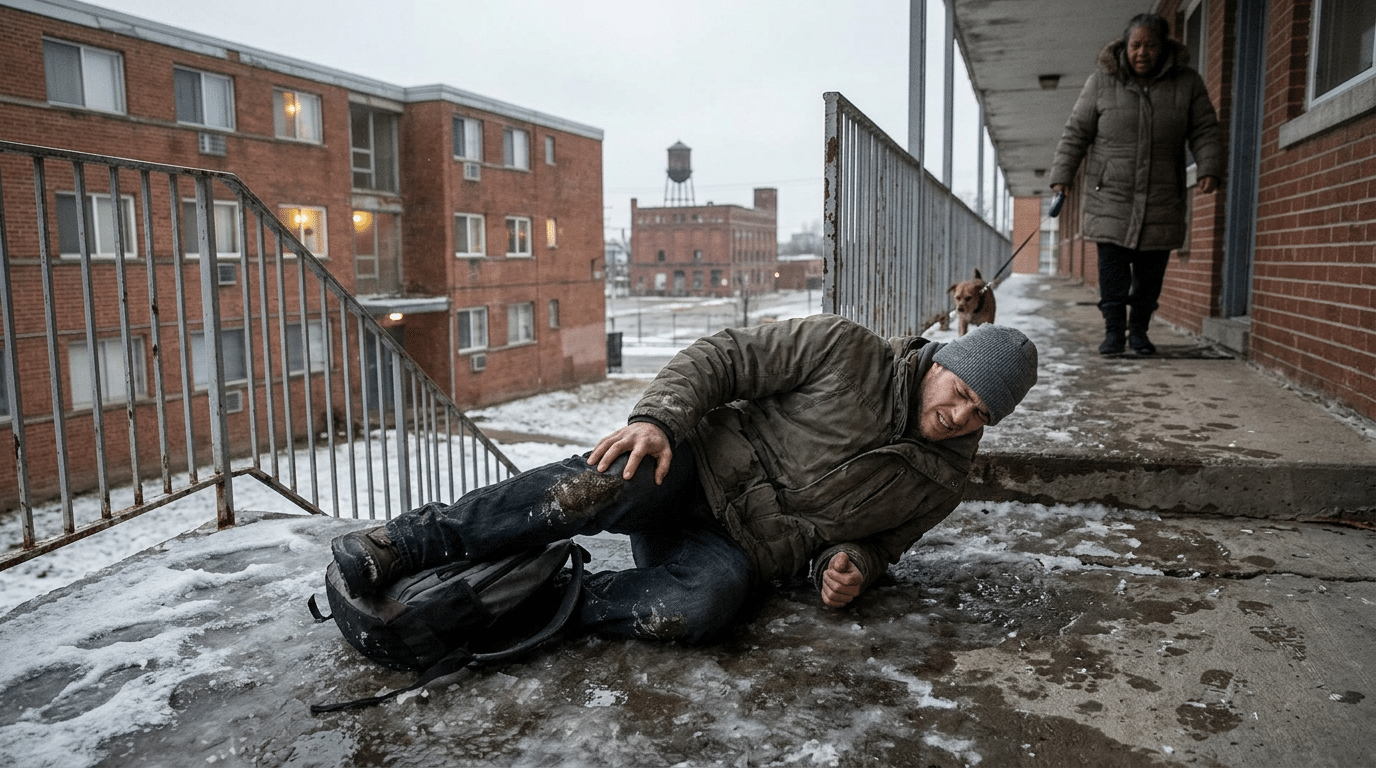
A fall at an apartment complex can leave a tenant, visitor, or family member with injuries that affect everyday life for months or even years. Apartment properties contain stairways, sidewalks, parking lots, hallways, entrances, laundry rooms, and other common areas that residents must regularly use.
When those areas are poorly maintained, a simple trip to the car or walk down the stairs can result in a fractured hip, torn ligament, back injury, concussion, or other serious harm. Michigan law imposes important responsibilities on landlords and other parties that possess and control residential property.
When a dangerous condition causes an injury, we examine who controlled the area, how long the hazard existed, whether reasonable steps should have been taken to correct it, and what legal duties applied.
We represent injured people in Detroit whose falls were caused by unsafe property conditions rather than ordinary accidents with no responsible party. Apartment slip and fall cases are highly fact-specific, and proving the cause of the fall is only one part of the claim.
We must also establish the legal responsibility of the landlord, property manager, maintenance company, or another party connected with the property.
When An Apartment Complex May Be Liable For A Slip And Fall
Michigan premises liability law generally requires a land possessor to exercise reasonable care to protect invitees from unreasonable risks of harm caused by dangerous conditions on the property. Tenants are generally treated as invitees of their landlords, and landlords can also owe duties to guests using apartment common areas.
A successful claim usually requires more than showing that an injury occurred on apartment property. We investigate the condition that caused the fall and whether the defendant knew or reasonably should have known about it. Actual notice may exist when tenants previously complained about a broken stair, leaking pipe, defective handrail, or recurring ice problem. Constructive notice may be established when a condition existed long enough, or was sufficiently apparent, that reasonable property management should have discovered it.
Photographs, maintenance records, prior complaints, incident reports, surveillance footage, witness accounts, and inspection records can therefore become important evidence.
Michigan Law Requires Landlords To Maintain Residential Property
Michigan provides apartment tenants with protections beyond ordinary premises liability principles. Under MCL 554.139(1)(a), residential landlords covenant that the premises and common areas will be fit for the use intended by the parties. The statute also addresses a landlord’s obligation to keep residential premises in reasonable repair and comply with applicable state and local health and safety laws under MCL 554.139(1)(b), subject to the statute’s terms and exceptions.
The distinction between the leased premises and apartment common areas can matter. Michigan courts analyze claims involving common areas under the statutory requirement that those areas remain fit for their intended use.
An apartment walkway, for example, is intended to permit residents to walk to and from their homes. A stairway must be usable as a stairway. A common entrance must provide residents reasonable access to the building. Whether a particular defect makes a common area unfit depends on the circumstances rather than on whether the property could have been maintained in an even better condition.
Common Hazards That Cause Apartment Slip And Fall Injuries
Apartment complexes can present many preventable hazards. We commonly examine claims involving accumulated ice and snow, broken steps, missing or loose handrails, cracked pavement, potholes, uneven sidewalks, inadequate lighting, water leaks, defective flooring, loose carpeting, debris, and unsafe entryways.
Winter conditions deserve particular attention in Michigan. Property owners do not automatically become liable every time someone falls on snow or ice. The circumstances surrounding the accumulation, maintenance of the area, notice of the condition, actions taken by property management, and applicable legal duties all matter.
A landlord may also have contracted with a snow-removal or maintenance company. When that occurs, we investigate the contracts and conduct of every potentially responsible party rather than assuming the landlord is the only possible defendant.
Michigan’s Open And Obvious Rule Has Changed
Anyone investigating a Michigan slip and fall claim needs to understand the Michigan Supreme Court’s decision in Kandil-Elsayed v F & E Oil, Inc., 512 Mich 95 (2023). Older Michigan cases were frequently dismissed because the dangerous condition was considered open and obvious.
The Michigan Supreme Court changed that framework. The open and obvious nature of a condition no longer automatically eliminates the land possessor’s duty to exercise reasonable care toward an invitee. Instead, whether a hazard was obvious may be considered when evaluating whether the property owner breached the duty of care and whether the injured person shares comparative fault.
This is especially important when insurance companies rely on older arguments suggesting that seeing ice, a damaged sidewalk, or another hazard necessarily defeats the case. Current Michigan law requires a more complete analysis.
Comparative Fault Can Reduce An Apartment Injury Recovery
A property owner may argue that the injured person was also careless. Michigan’s comparative fault statute, MCL 600.2959, can reduce recoverable damages based on the injured person’s percentage of fault.
Suppose a jury determines that a landlord was responsible for allowing an unsafe condition to remain but assigns some responsibility to the injured person for failing to exercise reasonable care. The damages can be reduced to account for that percentage of fault. If the plaintiff’s percentage of fault is greater than the aggregate fault of the other parties, Michigan law can bar recovery of noneconomic damages.
We therefore treat allegations of comparative fault seriously from the beginning of an apartment injury case.
Serious Injuries Caused By Apartment Falls
Falls can create substantial forces, particularly when someone falls down stairs or onto concrete. Injuries may include hip fractures, wrist fractures, ankle fractures, torn knee ligaments, herniated discs, shoulder injuries, spinal injuries, and traumatic brain injuries.
The financial consequences can extend well beyond the emergency room visit. Surgery may be followed by physical therapy, rehabilitation, assistive devices, time away from work, and future treatment. Some clients never regain the mobility or physical abilities they had before the fall.
When we value these claims, we consider both the immediate losses and the long-term effect the injury may have on work, independence, physical comfort, and normal activities.
Evidence Can Disappear Quickly At An Apartment Complex
One of the biggest problems in premises liability cases is that dangerous conditions can be repaired or disappear soon after an injury. Ice melts. Water is cleaned up. Broken stairs are repaired. Security video is overwritten. Maintenance personnel may alter the area before anyone thoroughly documents what existed at the time of the fall.
We want photographs and video of the condition whenever they are available. We may also seek surveillance footage, repair histories, inspection records, tenant complaints, snow-removal records, work orders, photographs, and witness statements.
Prompt investigation can make the difference between proving what happened and being left with an insurance company’s argument that there is insufficient evidence.
Michigan’s Deadline For Filing A Slip And Fall Lawsuit
Michigan generally provides a three-year limitations period for an action seeking damages for personal injuries under MCL 600.5805. The applicable deadline should never be assumed, however, because particular facts can affect legal rights and timing.
Waiting can also damage a case long before the formal limitations period expires. Evidence can disappear, and witnesses can become difficult to locate. We prefer to investigate serious apartment injury cases while evidence is still available.
FAQs About Apartment Complex Slip And Fall Injury Claims
Can We Sue An Apartment Complex If We Fell On Ice?
A claim may be possible, but liability is not automatic simply because ice caused a fall. We examine where the ice formed, how long the condition existed, whether the landlord knew or should have known about it under the applicable claim, whether the area was a common area, what snow and ice maintenance had been performed, and whether statutory duties under MCL 554.139 apply. Michigan’s current premises liability law also means that an insurer cannot necessarily end the analysis merely by arguing that the ice was visible. The complete circumstances surrounding the fall must be considered.
What If We Previously Complained About The Dangerous Condition?
Prior complaints can be valuable evidence. An email, maintenance request, text message, resident portal submission, or prior incident may help establish that property management had actual notice of the problem. We encourage injured clients to preserve copies of communications concerning broken stairs, inadequate lighting, leaks, damaged pavement, ice, or other hazards. Maintenance records may also show whether management knew about a recurring problem but repeatedly failed to correct it.
Can A Visitor Injured At An Apartment Complex Bring A Claim?
Potentially, yes. A tenant is not the only person who may have legal rights after an apartment injury. Guests can be owed common-law duties when using apartment common areas, although the precise duty depends on the circumstances and the person’s legal status on the property. The statutory landlord duties created by MCL 554.139 also require careful analysis because not every statutory protection applicable to a tenant automatically extends to a social guest. We evaluate the appropriate legal theory rather than treating every apartment fall the same way.
What Compensation Can We Pursue After A Serious Apartment Fall?
Depending on the facts, damages may include medical expenses, lost earnings, loss of future earning capacity, pain and suffering, disability, and other losses caused by the injury. A severe fracture, spinal injury, or traumatic brain injury may also require substantial future medical care. We document how the injury has affected employment, mobility, household responsibilities, recreation, sleep, independence, and other aspects of everyday life because the consequences of a serious fall are not measured by medical bills alone.
What If The Apartment Complex Says We Should Have Seen The Hazard?
That argument does not automatically defeat a Michigan premises liability claim. Following the Michigan Supreme Court’s 2023 decision in Kandil-Elsayed, the open and obvious nature of a condition is generally considered in evaluating breach and comparative fault rather than being treated as an automatic elimination of the land possessor’s duty to an invitee. We investigate whether the property possessor should have anticipated the harm, whether reasonable precautions were taken, and whether the injured person’s conduct contributed to the accident.
Should We Report The Fall To Apartment Management?
Yes. An injury should generally be reported promptly, and we recommend preserving a copy of any written report. We would avoid guessing about the cause of the fall or making unnecessary statements about fault before all facts are known. The important immediate steps are documenting where and how the fall occurred, identifying witnesses, preserving photographs or video, obtaining appropriate medical treatment, and preserving communications with property management.
Ravid & Associates, P.C. Can Help After A Serious Apartment Slip And Fall
An apartment complex injury may involve a landlord, management company, maintenance contractor, snow-removal company, or another party responsible for the dangerous condition. We investigate how the accident occurred, identify the parties that controlled or maintained the property, preserve evidence, review applicable Michigan law, and pursue compensation when negligence or a violation of a legal duty caused serious injuries.
Insurance companies may dispute notice, blame the person who fell, or argue that a dangerous condition should have been avoided. We build these cases around evidence rather than assumptions and work to establish why the condition existed, who was responsible for addressing it, and how the injury changed our client’s life.
We can review the circumstances of the fall, determine which Michigan premises liability and landlord laws may apply, identify potentially responsible parties, and explain the legal options available for pursuing compensation. When an unsafe apartment property causes a serious injury, we are prepared to investigate what happened and fight for our client’s rights. Call our Detroit premises liability attorneys at Ravid & Associates, P.C. today by calling (248) 948-9696 to receive your free consultation.

