
How Car Accidents Cause Herniated Discs and Permanent Back Problems
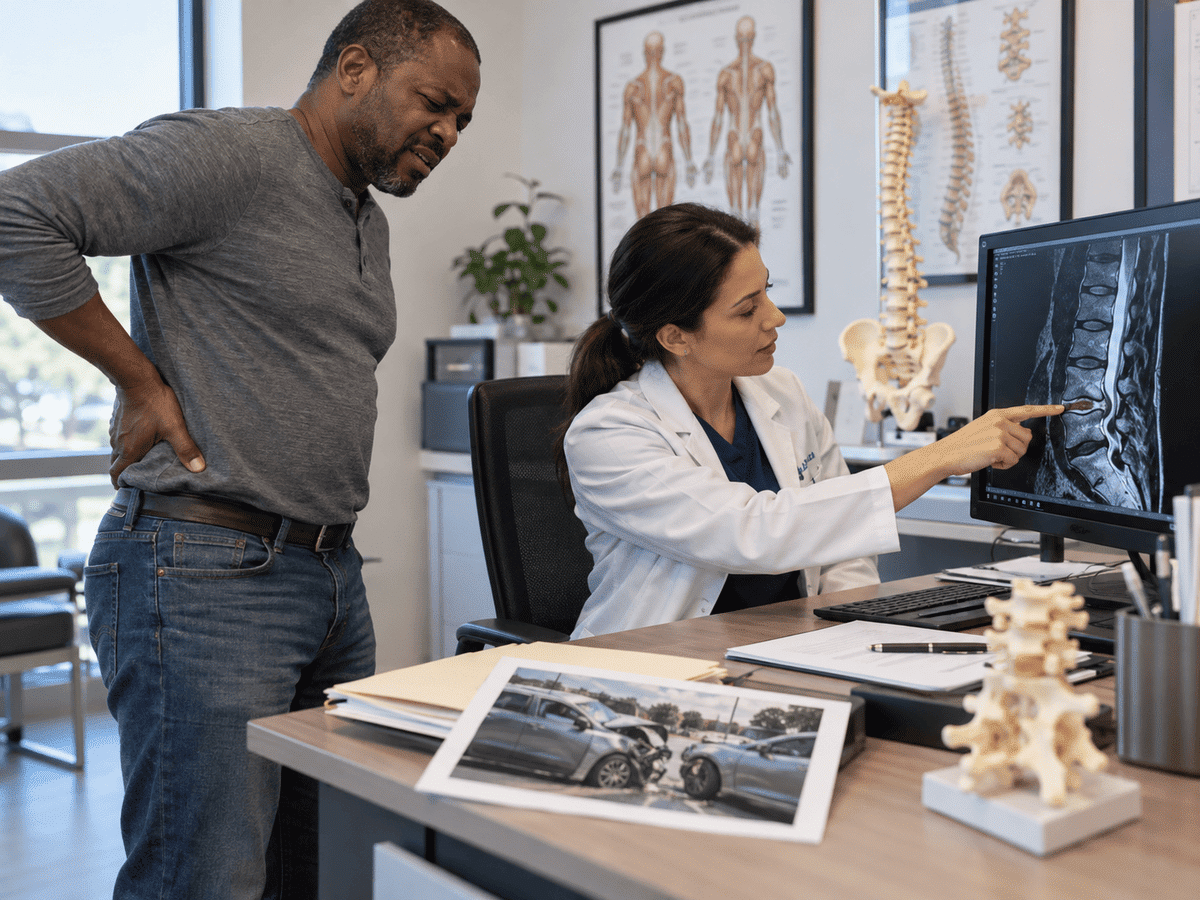
A serious car accident in Detroit can damage the spine in ways that are not immediately obvious at the crash scene. A person may initially feel soreness or stiffness and assume the pain will disappear within a few days. Instead, the symptoms may intensify as swelling develops and pressure increases around damaged spinal nerves. Herniated discs are among the back injuries we frequently see after rear-end collisions, side-impact crashes, rollover accidents, and high-speed impacts.
Some people recover with conservative treatment, while others are left with chronic pain, nerve problems, limited mobility, or the need for surgery. When another driver causes the collision, Michigan law may allow an injured person to recover compensation for both immediate losses and the long-term effects of the spinal injury.
How A Car Crash Can Cause A Herniated Disc
The spine is made up of vertebrae separated by discs that provide cushioning and help the back move normally. Each disc contains a softer inner material surrounded by a tougher outer layer. A sudden impact can place extreme pressure on the spine, causing a disc to tear, bulge, or rupture.
During a collision, the body may be thrown forward and backward faster than the spine can safely accommodate. Twisting during impact can place additional stress on the lower back. Even when the vehicle itself does not appear severely damaged, the forces transferred to an occupant can injure spinal structures.
A herniated disc becomes especially serious when displaced disc material presses against a nearby nerve. That compression may produce symptoms far beyond localized back pain.
Symptoms Can Extend Into The Legs And Feet
Lumbar disc injuries frequently cause symptoms that travel from the lower back into the hips, buttocks, legs, or feet. An injured person may develop numbness, tingling, burning pain, weakness, or sciatica.
Some symptoms appear immediately. Others become noticeable over several hours or days as inflammation increases around the injured area. This delayed onset sometimes gives insurance companies an opportunity to argue that the condition was unrelated to the collision.
We encourage injured people to accurately report every symptom to their medical providers and continue reporting changes as treatment progresses. The medical history created after an accident may become important evidence when establishing that the crash caused or aggravated the spinal condition.
Herniated Discs Can Lead To Long-Term Back Problems
Not every herniated disc requires surgery, but some injuries do not resolve with rest, medication, physical therapy, or injections. Persistent nerve compression can cause chronic pain and interfere with walking, sitting, lifting, sleeping, driving, and working.
Treatment may eventually include epidural steroid injections, nerve blocks, discectomy, spinal decompression, or spinal fusion. Surgery can also create a lengthy rehabilitation period and may not restore the person to the physical condition they enjoyed before the crash.
Permanent restrictions can be particularly damaging for people whose jobs involve construction, manufacturing, nursing, transportation, warehouse work, or other physically demanding duties. A back injury can therefore affect both quality of life and future earning capacity.
Michigan No-Fault Benefits May Help Pay For Treatment
Michigan’s No-Fault Insurance Act provides Personal Injury Protection benefits for qualifying motor vehicle accident injuries. Under MCL 500.3107, PIP benefits may include reasonable charges for reasonably necessary medical care, recovery, and rehabilitation, subject to the applicable coverage and statutory limitations.
Those benefits can become significant in a herniated disc case. Diagnostic imaging, specialist appointments, physical therapy, injections, surgery, rehabilitation, and other treatment can become costly.
Section MCL 500.3107 also provides qualifying wage-loss benefits for income an injured person would have earned during the first three years after the accident, subject to applicable statutory rules and limits. When a spinal injury prevents someone from returning to work, these benefits may provide an important source of financial support.
When A Herniated Disc Supports A Lawsuit Against The At-Fault Driver
PIP benefits and a liability claim against the negligent driver address different types of losses. To pursue noneconomic damages such as pain and suffering after a Michigan motor vehicle crash, the injured person generally must satisfy the threshold established by MCL 500.3135.
One way to satisfy that threshold is by proving a serious impairment of body function. A herniated disc may qualify when objective medical evidence demonstrates an injury to an important body function that affects the person’s general ability to lead their normal life.
We do not evaluate a disc case based only on what appears on an MRI. We also consider how the condition affects the person’s work, mobility, family responsibilities, recreational activities, sleep, and ordinary routines.
Pre-Existing Disc Problems Do Not Automatically Defeat A Claim
One of the most common insurance defenses involves degenerative disc disease. Insurers may obtain older medical records or point to imaging findings suggesting that some spinal degeneration existed before the crash.
That does not necessarily eliminate the claim. A collision can aggravate a previously asymptomatic condition or make an existing back problem substantially worse. The important questions include the person’s symptoms and abilities before the accident compared with what occurred afterward.
We may use earlier medical records, post-accident imaging, treatment records, physician opinions, employment documentation, and testimony about daily activities to establish how the collision changed the person’s condition.
Comparative Fault Can Affect Compensation
Michigan applies comparative fault principles to personal injury cases. Under MCL 600.2959, damages may be reduced according to the injured person’s percentage of fault.
If the injured person is found more at fault than the combined fault of others, noneconomic damages are unavailable under that statute. This makes liability evidence particularly important when a serious spinal injury leads to a substantial claim.
Crash reports, photographs, video recordings, witness testimony, vehicle data, and other evidence can help establish how the collision occurred and who was responsible.
Evaluating The Full Value Of A Permanent Back Injury
A settlement should account for more than medical bills that have already arrived. When a herniated disc creates permanent problems, the future consequences may be the most significant part of the claim.
We examine expected medical treatment, future surgery, rehabilitation, lost earnings, reduced earning capacity, physical limitations, and the effect of chronic pain on daily life. A person in their thirties who can no longer perform physical work may experience decades of financial consequences from a single collision.
Accepting compensation before the long-term prognosis is understood can leave an injured person responsible for substantial future costs that were never included in the settlement.
Frequently Asked Questions About Herniated Discs After Michigan Car Accidents
Can A Car Accident Cause A Herniated Disc Even If I Did Not Have Immediate Back Pain?
Yes. The physical trauma from a crash can damage a spinal disc even when severe symptoms do not appear immediately. Inflammation may develop after the accident, and damaged disc material can gradually irritate or compress nearby nerves. Some people first notice stiffness and later develop significant back pain, sciatica, numbness, or weakness. We recommend obtaining medical care when symptoms develop and giving physicians an accurate account of when and how those symptoms began.
Does An MRI Prove That My Car Accident Caused The Herniated Disc?
An MRI can provide important objective evidence showing disc herniation, bulging, nerve compression, and other spinal abnormalities, but the imaging alone does not necessarily prove when the injury occurred. We look at the entire medical record, including the accident mechanism, prior medical history, onset of symptoms, physical examinations, imaging results, and treating physicians’ conclusions. When those factors support one another, they can provide strong evidence connecting the spinal injury to the crash.
Can I Recover Compensation If I Already Had Degenerative Disc Disease?
Potentially, yes. Many adults have some degree of spinal degeneration before a car accident without experiencing disabling symptoms. A collision may aggravate an existing condition and turn a manageable or asymptomatic problem into chronic pain or neurological impairment. We focus on establishing the difference between the person’s condition before and after the crash and documenting how the collision changed their functional abilities.
What If My Doctor Says I May Need Back Surgery In The Future?
Potential future surgery can have a major impact on the value of an injury claim. We consider the expected cost of surgery, hospitalization, rehabilitation, time away from work, future medical care, and the possibility of permanent restrictions. When physicians believe surgery may reasonably be necessary, that future treatment should be evaluated before a settlement is accepted.
How Long Do I Have To File A Michigan Car Accident Injury Lawsuit?
Michigan’s general statute of limitations for personal injury actions is ordinarily three years under MCL 600.5805, although different deadlines and requirements can apply depending on the parties and claims involved. No-Fault benefit claims also have separate statutory requirements. We recommend addressing legal deadlines early rather than waiting until the end of the limitations period.
Speak With Ravid & Associates, P.C. About A Herniated Disc Injury
A herniated disc can turn one car accident into years of medical treatment, pain, work limitations, and uncertainty about future health. We investigate how the collision occurred, review medical evidence, address insurance disputes, and evaluate both the current and future consequences of serious spinal injuries. When another driver’s negligence caused the crash, we pursue the compensation available under Michigan law.
If a Michigan car accident caused a herniated disc, chronic back pain, nerve damage, or another serious spinal injury, contact our Detroit auto accident attorneys at Ravid & Associates, P.C. by calling (248) 948-9696 to receive your free consultation. We represent injured people in Detroit and throughout the entire state of Michigan from our office location in Southfield, Michigan. We can review what happened, explain the applicable insurance and injury laws, and discuss the legal options available for pursuing compensation.

